Carrier Fault & Error Codes in Pasadena
In plain terms: Carrier fault codes in Pasadena 91101 to 91107 name the failed subsystem: 178/179 are communication faults, 73 a capacitor code, 44 airflow restriction, and furnace 13/14/31/34 are lockouts. Call Pasadena Carrier HVAC at (213) 513-5436 or book online and we read the code at the Infinity control or count furnace LED flashes.
The short version
- Infinity systems show numeric and plain-language codes on the System Control touchscreen.
- Non-communicating units flash a numeric code through the control-board LED at the cabinet.
- Cooling/comm codes: 178 indoor comm, 179 outdoor comm, 73 capacitor, 44 air restriction, 54/56 sensors.
- Furnace codes: 13/33 limit, 14 ignition lockout, 31 pressure switch, 34 ignition-proving, 26 rollout, 24 control fuse.
- 26 rollout is a combustion-safety stop; power off and call.
- Service area Pasadena ZIPs 91101-91107.
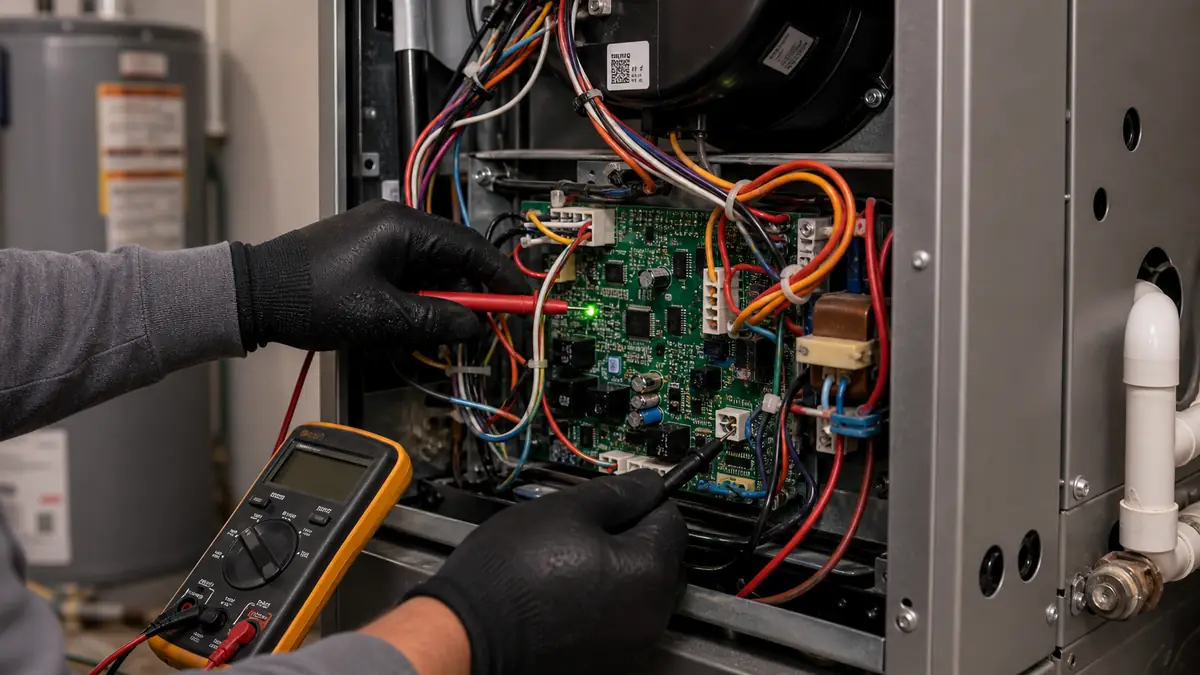
What do the common Carrier cooling codes mean?
On the cooling and communication side, the codes point straight at a subsystem. 178 and 179 are lost communication with the indoor or outdoor board. 73 flags voltage at the run capacitor with no compressor answering, usually a failed capacitor or welded contactor. 44 means the system sees excessive air-delivery restriction, often a clogged filter or duct problem. 54 and 56 are sensor faults. Each narrows the diagnosis before a tech opens the unit.
| Code | Meaning / first check | Cost lane |
|---|---|---|
| 73 | Run capacitor or welded contactor | $150-$450 |
| 44 | Excessive air restriction: filter, coil, ducts | $0-$3,500 |
| 178 / 179 | Indoor / outdoor ABCD communication fault | $150-$2,000 |
| 54 / 56 | Suction or outdoor-air-temp sensor fault | $150-$450 |
| 34 | Furnace ignition-proving failure: igniter/flame sensor | $150-$400 |
| 31 | Furnace pressure switch did not close: inducer/flue | $200-$700 |
| 13 / 33 | Furnace limit circuit: restricted airflow | $120-$600 |
| 26 | Furnace rollout: inspect heat exchanger (safety) | Diagnose first |
What do the furnace lockout codes mean?
The 58 and 59-series furnaces flash codes that map to the ignition sequence. 34 is ignition-proving failure, usually a weak igniter or a dirty flame sensor that cannot prove flame. 31 is a pressure switch that did not close, pointing at the inducer or a blocked flue or condensate. 13 and 33 are limit-circuit trips from restricted airflow. 14 is a hard ignition lockout after repeated failures. See furnace repair for the step-by-step diagnosis.
Which codes are safety stops?
A 26 rollout code is the one to respect: it can signal a cracked heat exchanger or a blocked flue, both combustion-safety problems. Power the furnace off and call rather than resetting it. Repeated 13/33 limit lockouts also warrant a flue and exchanger check. For communicating systems, the Infinity System Control stores fault history so we can see an intermittent problem that has been building.
How do I actually read the code off my unit?
There are two methods, depending on the equipment. On a communicating Infinity system, the System Control touchscreen does the work: open the service or fault menu and it lists the active code as a number plus a plain-language line, and it keeps a stored history of the last several faults with timestamps. That history is gold for an intermittent problem, because a 179 that clears itself on a cool morning and returns on a hot afternoon points straight at a heat-sensitive connection on the ABCD bus. On a non-communicating Performance or Comfort furnace, you read the amber LED through the small sight glass on the blower-door panel: Carrier flashes the first digit as short blinks and the second digit as long blinks, so three short flashes followed by four long flashes is code 34. Count a full cycle twice to be sure, because a miscount turns a pressure-switch problem into an ignition chase. Do not pull the door off while the burner is firing; read the LED through the window.
Which Carrier codes show up most in Pasadena?
The code you see tracks the season. Through a Climate Zone 9 summer, the cooling-side codes dominate: 73 voltage-at-the-capacitor-with-no-compressor after a capacitor cooks in the heat, 44 air-delivery restriction when a filter clogs during heavy runtime, and 178/179 communication faults when a control board that took on attic condensation or a corroded ABCD splice finally drops the link. Come the short heating season, the furnace lockouts take over: 34 ignition-proving from a dust-fouled flame sensor on a furnace that sat idle all summer, 31 pressure-switch from a wasp nest or debris in a flue, and 13 or 33 limit trips from a filter that never got changed. Matching the code to the season tells us which parts to load on the truck before we even reach your 91101 to 91107 address.
Deep dives on specific Carrier codes
Two of the codes above have full walkthroughs of their own for Pasadena homeowners. The Carrier 31 code page covers the furnace pressure-switch and draft fault: why an old Bungalow Heaven flue or a clogged condensate trap blocks the inducer from proving draft, how we meter it, and what the switch or inducer repair runs. The Carrier 178 code page covers the indoor Infinity communication fault on the ABCD bus: the loose terminals, baked attic wiring, and tripped condensate floats behind it, and how we trace the link before condemning a board.
Common questions
Where does my Carrier system show a fault code in Pasadena?
On a communicating Infinity system, the System Control touchscreen shows numeric and plain-language faults like 178 or 179. On non-communicating Performance and Comfort equipment, the furnace or air-handler control board flashes a numeric code through an LED visible at the cabinet sight glass. Count the flashes to read it.
Is a Carrier fault code an emergency, or can it wait?
It depends. A 26 rollout code on a furnace is a combustion-safety stop, so power it off and call. A 73 capacitor code or a 178/179 comm fault means the system is down but not dangerous, so it is a same-day or next-day repair. We triage by code over the phone before dispatching.
My Infinity screen says 'communication fault' with no number. What now?
A plain-language communication fault is the same family as 178/179: the control lost its link to the indoor or outdoor board over the ABCD bus. Check that the screen has power; a tripped condensate float switch can cut 24V and mimic a control failure. We verify wiring and voltage on site.
Can I clear a Carrier lockout by cycling the breaker?
A single power cycle can clear a soft lockout, and if it stays cleared the cause was transient. But repeated lockouts after a reset mean the underlying fault, ignition, pressure, or limit, is still there, and forcing the system to keep retrying can damage parts. Read the code and fix the cause rather than resetting in a loop.