High HVAC Energy Bills in Pasadena
In plain terms: High HVAC bills on a Carrier system in Pasadena 91101 to 91107 usually come from leaky attic ducts, a dirty condenser coil, low refrigerant, or an oversized unit, all of which raise runtime. Call Pasadena Carrier HVAC at (213) 513-5436 or book online and we measure amp draw, pressures, and duct leakage to find where the watts go.
The short version
- Climate Zone 9 is cooling-dominant: 25-40 days a year at or above 90 F drive the summer bill.
- Top efficiency drains: dirty coil, low refrigerant, leaky/undersized ducts, oversized or short-cycling unit.
- Attic ducts in older homes can lose 20-30% of cooled air into a 120 F-plus attic.
- We measure compressor amp draw, pressures, and Title-24 duct leakage to isolate the cause.
- Fixes range from a $99 coil clean to duct sealing or a right-sized Greenspeed system.
- Service area Pasadena ZIPs 91101-91107.
Where does the extra money go on a Pasadena summer bill?
It goes to runtime. Anything that lowers capacity or wastes cooled air makes the compressor run longer to hold setpoint, and the compressor is the biggest electrical load in the house. In Pasadena that shows up sharply because the foothill heat island and Santa Ana events stack 90 F-plus days. A 10 percent efficiency loss from a dirty coil or a small leak is invisible until the SCE bill lands.
| Cause | What it does / first check | Fix lane |
|---|---|---|
| Dirty condenser coil | Raises head pressure, cuts capacity | $99-$250 clean |
| Low refrigerant (leak) | Drops capacity, longer runtime | $225-$1,500 |
| Leaky attic ducts | 20-30% cooled air lost; HERS verify | $800-$3,500 seal |
| Oversized / short-cycling | Cycles, never dehumidifies | Right-size on replacement |
| Aging compressor | High amp draw vs nameplate | Repair vs replace |
How do you find the efficiency leak?
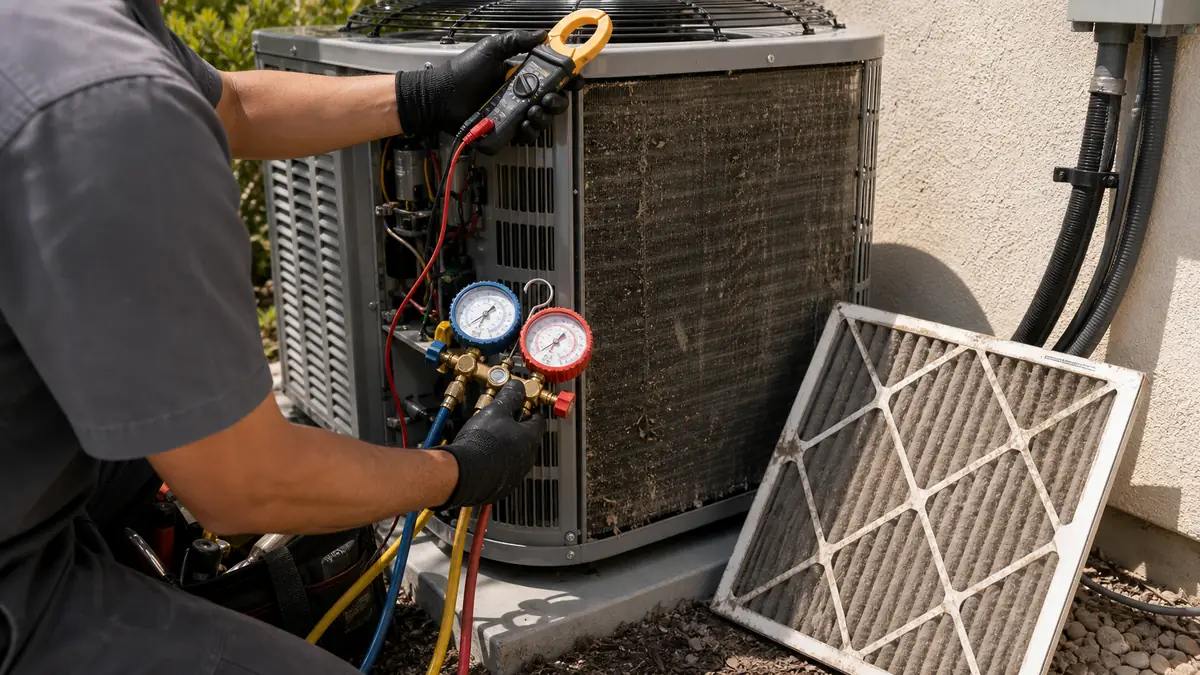
We measure rather than guess. A clamp meter reads compressor amp draw against the nameplate to flag an aging or struggling unit. Gauges show refrigerant charge and coil condition. A manometer reads static pressure, and a duct-leakage test quantifies house losses. That split tells you whether to spend on a duct seal, a coil cleaning, a refrigerant repair, or a right-sized replacement, instead of throwing money at the wrong thing.
How much does an efficiency loss actually cost per summer?
Put rough numbers on it. Say a 3-ton Carrier condenser draws about 3.5 kW running and logs 1,000 cooling hours across a Pasadena summer, with 25 to 40 days over 90 F driving long afternoons. That is roughly 3,500 kWh a season, and at a typical SoCal residential rate the cooling alone is a meaningful slice of the bill. Now layer on the losses: a dirty condenser coil that cuts capacity 10 percent makes the compressor run about 10 percent longer for the same comfort, attic ducts leaking 25 percent of their air dump a quarter of what you paid to cool into a 120 F-plus attic, and a half-pound-low charge can shave another 5 to 10 percent of capacity. Stack those and a system can easily run 30 to 40 percent more hours than it should, which is exactly the jump that lands as a startling July bill. The fixes, a $99 to $250 coil clean, $800 to $3,500 of duct sealing, or a $225 to $1,500 charge repair, each claw back a chunk of that runtime.
Why do Pasadena attic ducts leak so much?
Many Pasadena homes had central ducting retrofitted into Craftsman and Spanish-revival houses that were never designed for it, so the runs were threaded through cramped attics and crawlspaces with whatever fittings fit, and the old cloth-and-mastic or early flex connections degrade over decades. A boot that pulled loose from a register, a trunk seam that opened, or flex that crushed against a rafter all bleed conditioned air before it reaches the room. Because that air leaks into an attic that hits 120 F-plus on a Santa Ana afternoon, the loss is pure waste. We quantify it with a duct-leakage test rather than eyeballing it, and in Climate Zone 9 a duct alteration triggers Title-24 HERS duct-leakage verification anyway, so sealing gets measured and signed off. A tightened duct system is often the single highest-return fix on an older Pasadena home's summer bill.
Would a new system actually pay back?
It can. A 15-year-old single-stage Carrier unit logging long hours through every Pasadena summer can burn enough in runtime that a right-sized Greenspeed system on sealed ducts earns its keep over the years it runs, more so if a utility rebate is open while you buy. We lay out the numbers straight, and that includes the reality that the federal 25C credit closed on December 31, 2025. The SEER2 and rebates guide tracks where the incentives stand now.
Common questions
Why did my Pasadena summer electric bill jump even though nothing broke?
A system can lose efficiency without failing. A condenser coil caked with foothill dust raises head pressure, a slow refrigerant leak drops capacity so the unit runs longer, and attic-duct leakage in a 1920s home dumps cooled air before it reaches the rooms. All three raise runtime and the SCE bill without a single error code.
Is an oversized Carrier AC actually costing me money?
It is. Too much capacity makes a unit short-cycle: it drives the air cold fast, then kills the compressor before it has wrung out humidity or balanced the rooms, so it restarts again and again and chews through component life. The fix is matching tonnage to a Manual J load calc, or running a variable-speed Greenspeed unit that modulates and simply throttles down instead of slamming on and off, which holds setpoint on less energy.
Will a smart thermostat cut my Pasadena cooling bill much?
Some, through scheduling and setbacks during cooler foothill nights. But the larger savings in Climate Zone 9 come from sealed ducts, a clean coil, correct refrigerant charge, and a right-sized system. A smart stat helps most as part of that package, not on its own.
How do I tell if it is the equipment or the house?
We measure both. A clamp meter reads the compressor's actual amp draw against the nameplate, pressures show charge and coil condition, and a static-pressure and duct-leakage check shows house losses. That separates an aging compressor from a leaky duct system so you spend on the right fix.