Carrier Furnace Repair in Pasadena
In plain terms: Pasadena Carrier HVAC repairs Carrier gas furnaces across Pasadena, from Historic Highlands 91104 to Garfield Heights, decoding 13, 14, 31, and 34 lockouts on 58 and 59-series furnaces and fixing igniters, flame sensors, and limits. Call (213) 513-5436 or book online for a no-heat diagnosis, same-week on most Pasadena calls.
The short version
- Repairs Carrier 59-series condensing (59MN7 modulating, 59TN/59TP 2-stage, 59CU5 Ultra-Low NOx) and 58-series 80% furnaces.
- Reads flash codes: 13/33 limit circuit, 14 ignition lockout, 31 pressure switch, 34 ignition-proving, 26 rollout.
- Common parts: hot-surface igniter, flame sensor, inducer motor, pressure switch, high-limit, gas valve, control board, ECM blower.
- Cost lanes: igniter/flame sensor $150-$400; inducer or gas valve $300-$900; control/ECM higher.
- Combustion-safety checks on rollout and repeated limit trips (cracked heat exchanger, blocked flue).
- Service area: Pasadena ZIPs 91101, 91103, 91104, 91105, 91106, 91107.
What are the most common Carrier furnace faults in Pasadena?
Because Pasadena winters are mild, furnaces sit idle for months and then fail on the first cold snap. The classic no-heat calls are a worn hot-surface igniter, a flame sensor coated in oxide so it cannot prove flame, and a pressure switch stuck open after a summer of dust. On 58 and 59-series furnaces the control board flashes a numeric code through its LED that tells us where to look before we open the cabinet.
| Flash code / symptom | Likely cause / first check | Cost lane |
|---|---|---|
| 34 ignition-proving failure | Weak hot-surface igniter or dirty flame sensor | $150-$400 |
| 31 pressure switch did not close | Inducer, blocked flue/condensate, or switch | $200-$700 |
| 13/33 limit circuit lockout | Restricted airflow: filter, return, or blower | $120-$600 |
| 14 hard ignition lockout | Repeated failed ignition; igniter/gas valve | $200-$900 |
| 26 rollout switch | Inspect heat exchanger and flue (safety) | Diagnose first |
| 24 control fuse open | Shorted low-voltage wire or failed transformer | $120-$400 |
| 45 control circuitry lockout | Failed integrated furnace control board | $300-$900 |
| Starts then no blower | ECM blower module or motor fault | $450-$2,300 |
Which Carrier furnace families do these repairs cover?
Pasadena's attics and closets hold a wide spread of Carrier furnaces, and the repair differs by family. We service the current and recent lineup:
- 59MN7 Infinity 98. Modulating gas valve plus a variable-speed ECM blower, up to ~98 AFUE. Communicating, so it reports numeric and plain-language codes at the Infinity control. Faults skew toward the modulating gas valve, the ECM module, and communication wiring.
- 59TN7 / 59TN6 Infinity and 59TP6 Performance. Two-stage, variable-speed, ~96-97 AFUE. Common comfort upgrades; igniter, flame sensor, pressure switch, and inducer are the usual repairs.
- 59CU5 Ultra-Low NOx and 59SC6 Comfort. Single-stage condensing. The 59CU5 meets California emissions rules, which matters when a unit must be replaced rather than repaired.
- 58-series (58TN / 58TP / 58SC) 80% AFUE. Non-condensing, atmospheric or induced-draft, still very common because Pasadena's short heating season rarely justifies condensing efficiency. Simple venting, no condensate trap, and straightforward igniter, inducer, and gas-valve repairs.
How do you diagnose a no-heat Carrier furnace?
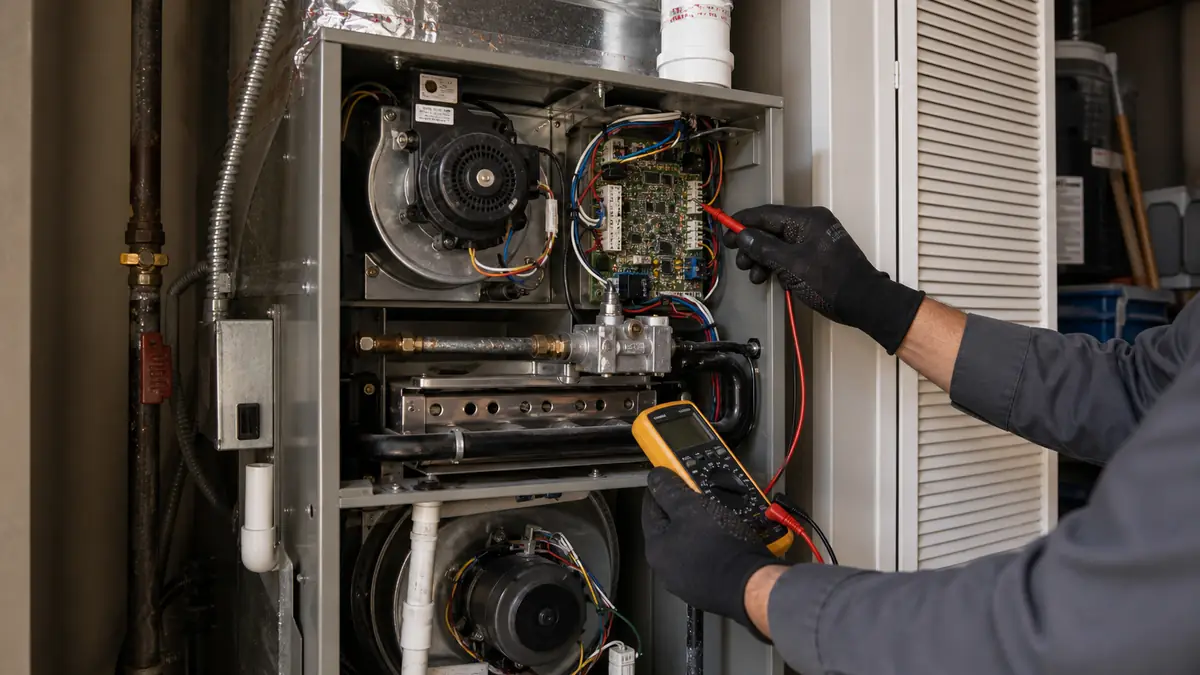
We read the flash code, then verify each stage of the ignition sequence: 24V to the board, inducer spin-up, pressure switch closing, igniter glow and resistance, gas-valve opening, and flame sense in microamps. A flame sensor reading below about 1 microamp will not hold the valve open, so a $20 cleaning often fixes a furnace someone else condemned. We also take static pressure to catch the airflow problems that trip the high limit.
What does a furnace repair cost in Pasadena, and what drives it?
The bill is the diagnostic visit (near $139, usually credited toward the work) plus the part-and-labor lane. The cheapest and most common no-heat fix is the ignition train: a hot-surface igniter or a flame-sensor cleaning at $150 to $400. A pressure switch or inducer motor sits at $200 to $700. A gas valve or a hard ignition lockout that needs the valve and igniter together runs $200 to $900. The high end is the electronics - a control board at $300 to $900, or a variable-speed ECM blower module or motor at $450 to $2,300 on a 59MN7-class furnace.
Two Pasadena specifics shape the cost. Access matters: many furnaces here sit in cramped hall closets or low attics in 1920s homes, which adds labor on a board or blower swap. And combustion safety can stop a cheap repair cold - if a rollout code (26) or repeated limit lockouts reveal a cracked heat exchanger on an aging 80% unit, we red-tag it rather than clear the code, and the conversation shifts to replacement.
When is a furnace repair a safety stop?
A rollout switch trip (code 26) or repeated limit lockouts can signal a cracked heat exchanger or a blocked flue, both combustion-safety problems. We test for flue-gas spillage and inspect the exchanger rather than just resetting the board. If we find a cracked exchanger on an aging 80% unit, we red-tag it and walk you through repair-versus-replace, including a possible heat-pump conversion while utility rebates apply.
Repair or replace an older Pasadena furnace?
Once a 58-series 80% furnace is 18-20 years old and drops a major part, replacing it usually beats rebuilding it, all the more because California's Ultra-Low NOx rules narrow what you are even allowed to install. By contrast, a 5-year-old 59MN7 with a bad igniter is a simple repair. We hand you both numbers and never lean on a replacement to fill a quota. For the efficiency and rebate side of the math, see the SEER2 and rebates guide.
Common questions
My Carrier furnace clicks but won't light on a cold Pasadena morning. What is it?
On a 58 or 59-series furnace, click-but-no-flame is usually a cracked or worn hot-surface igniter, a dirty flame sensor that cannot prove flame, or a pressure switch that did not close. The control logs a flash code: 34 is ignition-proving failure, 31 is the pressure switch. We test the igniter resistance and clean or replace the flame sensor first.
Is a Carrier furnace repair safe to delay, or is it a carbon-monoxide risk?
A rollout code (26) or repeated limit lockouts can point to a cracked heat exchanger or blocked flue, which is a combustion-safety issue we do not delay. We test for spillage and check the heat exchanger before clearing a lockout. A simple igniter or flame-sensor fault is not a CO risk and is a routine same-week repair.
Why does my furnace start then shut off after a few minutes?
Short-cycling on heat usually means the high-limit switch is tripping on overheat, often from restricted airflow: a clogged filter, closed returns, or a failing ECM blower. Code 13 or 33 points at the limit circuit. We check static pressure and the blower before assuming the limit switch itself failed.
Do you repair the 80% furnaces still common in older Pasadena homes?
Yes. Many Pasadena attics and closets hold Carrier 58-series 80% AFUE furnaces, which suit the mild climate. We repair igniters, inducer motors, gas valves, and control boards on those just as on the 59-series condensing units, and we tell you honestly when a 20-year-old unit is better replaced than rebuilt.
What does Carrier code 31 mean, and is it a quick fix?
Code 31 means the pressure switch did not close or reopened during the cycle, which protects against venting problems. The usual causes are a weak inducer motor, a blocked flue or condensate trap on a 59-series condensing unit, or a cracked switch hose. We test inducer draft and clear the condensate path before replacing the switch itself, which keeps it in the $200-$700 lane.
Why does my Carrier furnace smell like dust or burning when it first runs?
A faint dusty smell on the first burn of the season is normal: dust settled on the heat exchanger over a long Pasadena summer burns off. A persistent burning-plastic or electrical smell is not normal and points to an overheating blower motor, a failing control board, or restricted airflow tripping the limit. Shut it down and call if the smell does not clear in a few minutes.
How much does a typical Carrier furnace repair cost in Pasadena?
Most no-heat calls land between $150 and $900. A hot-surface igniter or flame-sensor cleaning is $150-$400, a pressure switch or inducer is $200-$700, and a gas valve or hard ignition lockout runs $200-$900. An ECM blower module is higher, $450-$2,300. The diagnostic visit near $139 is usually credited toward the repair.