Carrier HVAC Maintenance Plans in Pasadena
In plain terms: Pasadena Carrier HVAC runs maintenance plans across Pasadena, from Madison Heights 91106 to Old Pasadena, with pre-summer visits that test capacitors, read pressures, clean the coil, and clear the condensate drain before a 100 F July day. Call (213) 513-5436 or book online to enroll in a $99 to $350 yearly plan.
The short version
- Spring cooling visit plus fall heating visit, tuned to Climate Zone 9's cooling-dominant load.
- Cooling check: capacitor microfarads, contactor, pressures, temperature split, coil cleaning, condensate drain and float switch.
- Heating check: igniter, flame sensor, inducer, pressure switch, and limit circuit on 58/59-series furnaces.
- Pulls stored fault history at the Infinity control on communicating systems.
- Helps keep Carrier parts-warranty conditions met and holds rated efficiency.
- Cost lane $99-$350 per year depending on visits and system count. Pairing a plan with a larger repair? Let us know at enrollment and we will go over the financing on the table.
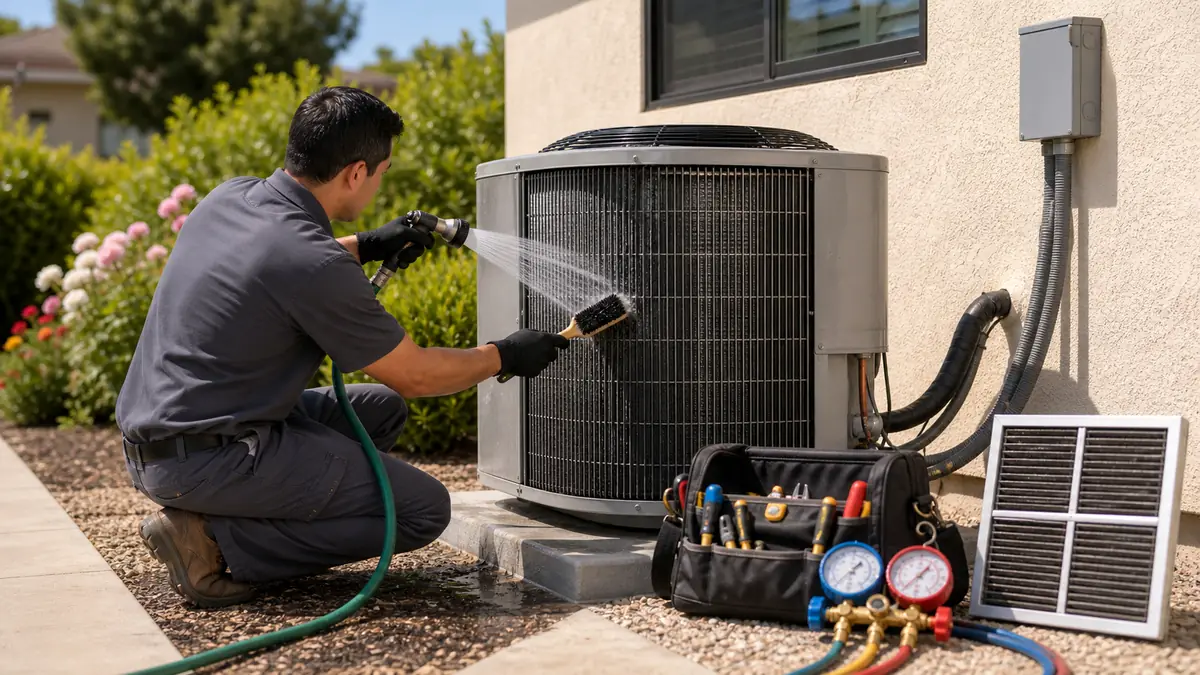
Why does maintenance matter more in Pasadena's heat?
Pasadena sits in cooling-dominant Climate Zone 9, with roughly 25 to 40 days a year at or above 90 F and Santa Ana spikes past 100 F. That load is hard on capacitors and condenser coils. A capacitor weakened over a summer of side-yard heat will read low on a meter long before it fails outright, so a spring tune-up turns a July emergency into a planned spring repair. A coil caked with foothill dust raises head pressure and quietly inflates the bill.
The foothill setting compounds it. Santa Ana wind events drive dust and debris into condenser fins and can push temperatures past 100 F in a single afternoon, which is exactly when a marginal part chooses to quit and when same-day dispatch is hardest to get. Condensers tucked into the narrow side yards of dense Old Pasadena and Bungalow Heaven lots, often against a hot south wall, run with elevated head pressure that accelerates wear. A system that is checked, cleaned, and charge-verified each spring weathers those spikes; one that is not tends to fail at the worst possible moment.
| Tier | Includes | Typical lane |
|---|---|---|
| Cooling-only | 1 spring visit: capacitor, charge, coil, drain | $99-$180/yr |
| Cooling + heating | 2 visits: full AC and furnace check | $180-$300/yr |
| Multi-system | 2 visits per system; priority dispatch | $280-$350+/yr |
What gets checked on a cooling visit, point by point?
The pre-summer cooling tune-up follows a set list, every line item covered before the tech leaves your Pasadena driveway:
- Capacitor microfarads measured against the nameplate rating - the single best predictor of a summer no-cool failure.
- Contactor inspected for pitting and chatter; condenser fan motor and blower amperage checked.
- Suction and liquid pressures read, with superheat and subcooling confirmed against the model's charging chart.
- Supply-return temperature split verified across the coil (a healthy split is roughly 16-22 F).
- Condenser coil rinsed clear of foothill dust to drop head pressure.
- Condensate drain cleared and the float (safety) switch tested so it does not nuisance-trip the 24V circuit.
- Filter checked and changed, and static pressure read to catch duct or return restrictions.
- On a Greenspeed Infinity system, stored fault history pulled at the control - often showing an intermittent issue before it becomes a failure.
What is the Pasadena maintenance calendar through the year?
The schedule is tuned to Climate Zone 9's cooling-dominant load, where the system earns its keep from May through October:
- March-April: the cooling tune-up. Capacitor, charge, coil, and drain checked before the first 90 F stretch, so a marginal part is a planned spring repair rather than a July emergency.
- May-September: homeowner filter checks every 1-3 months, more often after Santa Ana dust. Keep two feet of clearance around the side-yard condenser and hose dust off the coil fins.
- October-November: the heating tune-up. Igniter, flame sensor, inducer, pressure switch, and limit circuit checked on the 58/59-series furnace before the first cold morning.
- December-February: light heating season here; watch for furnace flash codes on the first cold snap after months of idle, when igniters and stuck pressure switches show up.
For the full month-by-month detail, see the Pasadena maintenance calendar.
What does a tune-up actually prevent?
The point of maintenance is converting surprise failures into planned ones. A capacitor reads low on a meter weeks before it fails outright, so a spring check catches it as a $150-$450 part instead of a no-cool call on a 100 F Santa Ana afternoon when dispatch is slammed. A coil rinsed of foothill dust drops head pressure, which both lowers the bill and takes strain off the compressor - the $1,200-$3,500 part you most want to protect. A cleared condensate drain and tested float switch stop the slow water leak that backs up and nuisance-trips the system or damages a ceiling. On the heating side, an October check that finds a weak igniter or an oxidized flame sensor heads off the classic first-cold-morning no-heat call in December.
Does maintenance protect my Carrier warranty?
Carrier's parts warranty generally expects documented annual maintenance, and a neglected system that fails can give the manufacturer grounds to question a claim. A plan keeps that paper trail and keeps a variable-speed system at its rated SEER2. If a covered part does fail while you are in warranty, we point you to factory-authorized service first, because that part is paid for. See the maintenance calendar for the month-by-month schedule.
Common questions
When should I schedule maintenance for a Pasadena summer?
Book the cooling tune-up in March or April, before the first 90 F-plus stretch. Capacitors and contactors that are marginal will hold through a mild spring and then fail on a 100 F Santa Ana afternoon, exactly when dispatch is busiest. A pre-season check catches a weak capacitor while it is still a planned $300 part.
What does a Carrier maintenance visit actually include?
We test capacitor microfarads against the nameplate, check contactor condition, read suction and liquid pressures and the temperature split, clean or rinse the condenser coil, clear the condensate drain and test the float switch, and inspect the furnace ignition train. On Infinity systems we pull stored fault history at the control.
Is a maintenance plan worth it on a newer Carrier system?
Yes, for two reasons. Annual service is often a condition of keeping Carrier's parts warranty valid, and a clean coil plus verified charge keeps a Greenspeed system at its rated efficiency in our heavy cooling climate. Skipping it lets a dirty coil push head pressure up and quietly raise your summer bill.
Do you cover both heating and cooling in one plan?
Yes. A plan typically includes a spring cooling visit and a fall heating visit, which fits Pasadena's split systems where one furnace and one condenser share the same blower. Catching a worn igniter in October is far cheaper than a no-heat call on the first cold morning in December.
How often should I change the filter on a Pasadena Carrier system?
Check a 1-inch filter monthly and change it every 1-3 months, more often during summer runtime and after a Santa Ana dust event. A 4- or 5-inch media filter lasts 6-12 months. A clogged filter is the single most common cause of code 13 limit lockouts and code 44 airflow faults, so it is the cheapest failure to prevent.
Will maintenance lower my Pasadena summer electric bill?
It helps. A condenser coil caked with foothill dust raises head pressure and makes the compressor work harder, quietly adding to the bill all summer. A verified refrigerant charge and a clean coil keep a Greenspeed system near its rated SEER2. Sealed ducts and the right-sized system matter more, but a clean, charged unit is the baseline.
What happens if I skip a year of maintenance on a newer Carrier unit?
One missed year rarely kills a system, but it stacks risk: a weak capacitor that a spring check would have caught fails on a 100 F July day, and a dirty coil shortens compressor life. It can also give Carrier grounds to question a parts-warranty claim, since the warranty generally expects documented annual service.